When I last sat down with Justin Benson back in July 2025, he dropped a hint about where Shilo was headed, specifically around DiSC personality assessments and how AI could build them from real calls instead of questionnaires. At the time, it sounded ambitious. Now that Signals is here, it’s way cooler than I thought it would be.
Every team leader in real estate has faced this moment: you’ve got a talented agent who crushes it in person but sounds like a robot on the phone. Or the reverse, an agent whose calls are magnetic but who can’t seem to close at the kitchen table. You know something is off. You just can’t pinpoint what.
The standard industry answer has been personality assessments. Take a DiSC quiz, get a four letter label, attend a workshop, and hope the insights stick. But here’s the problem nobody talks about: those assessments capture who agents think they are, not who they actually are when a skeptical seller pushes back on price or a buyer goes silent after the third showing.
First, a Quick Primer on DiSC and Why It Matters in Real Estate
If you’re unfamiliar, DiSC is a behavioral framework developed from research by Dr. William Moulton Marston at Harvard. It maps people across four dimensions: Dominance, which is direct and results driven; Influence, which is outgoing and enthusiastic; Steadiness, which is patient and relationship focused; and Conscientiousness, which is precise and detail oriented.
Real estate has adopted DiSC more enthusiastically than almost any other industry, and for good reason. This is a relationship business where communication style can make or break a deal. A high D client wants you to cut to the chase. A high S client needs to feel heard before they’ll trust your recommendation. Knowing the difference and adjusting on the fly is the gap between a good agent and a great one.
The challenge is that traditional DiSC assessments are self reported questionnaires. Agents answer how they believe they behave, which may not reflect how they actually perform under pressure. And those results are static, a snapshot from the day the agent took the test, even if their communication patterns have evolved significantly since then.
What Shilo Signals Actually Does
Signals builds DiSC behavioral profiles automatically from the calls agents are already making. No questionnaires. No workshops. No extra steps.
The system listens to weeks or months of real call recordings, pulled through existing phone systems and CRM integrations, and analyzes them using Shilo’s proprietary models. Those models have been trained on what the company says is more than 21 years of continuous talk time across over 7,000 real estate agents, drawn from more than 3 million processed calls. Shilo describes this as the largest dataset of analyzed real estate conversations in the industry.
Each agent gets a Signals profile that includes:
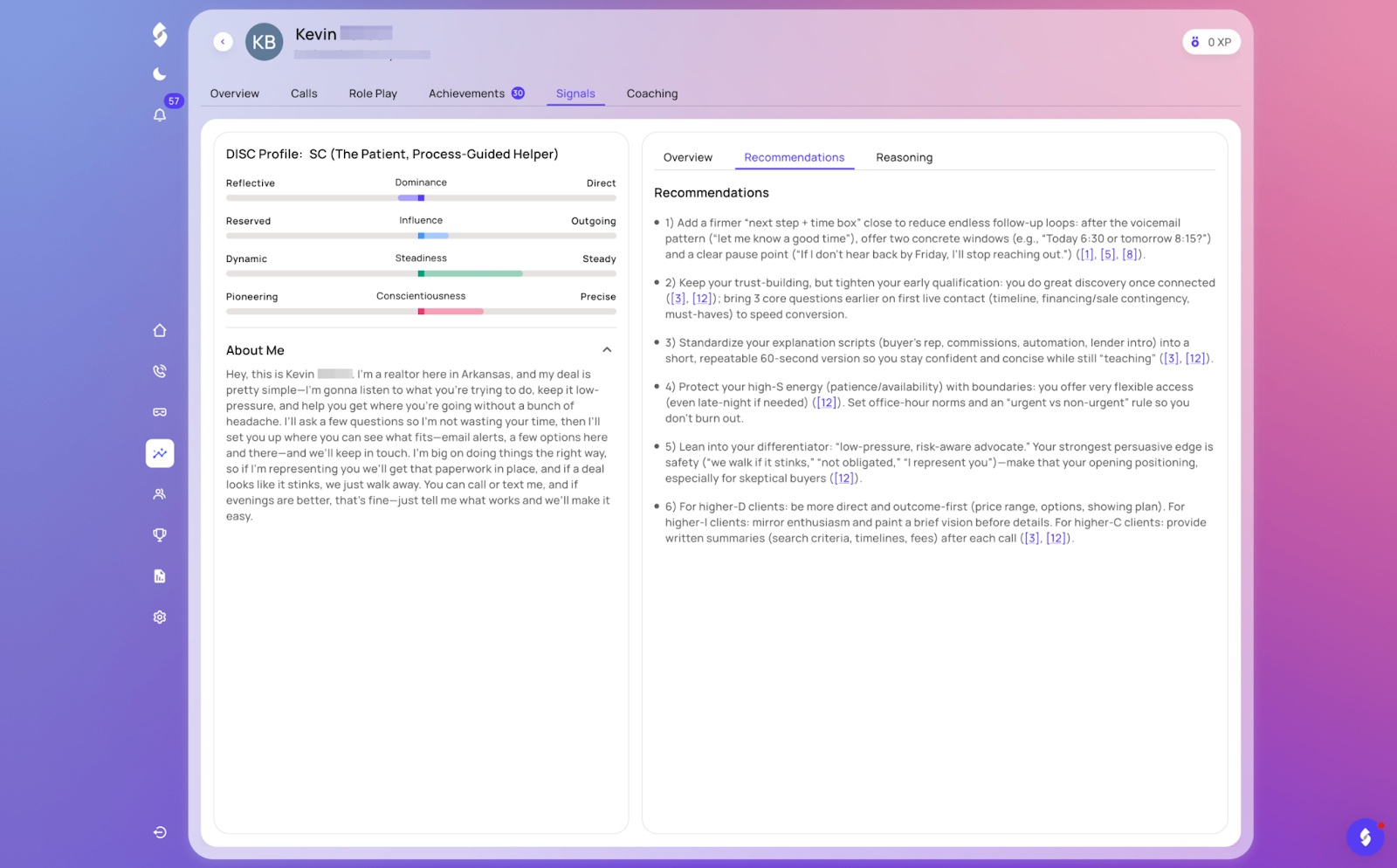
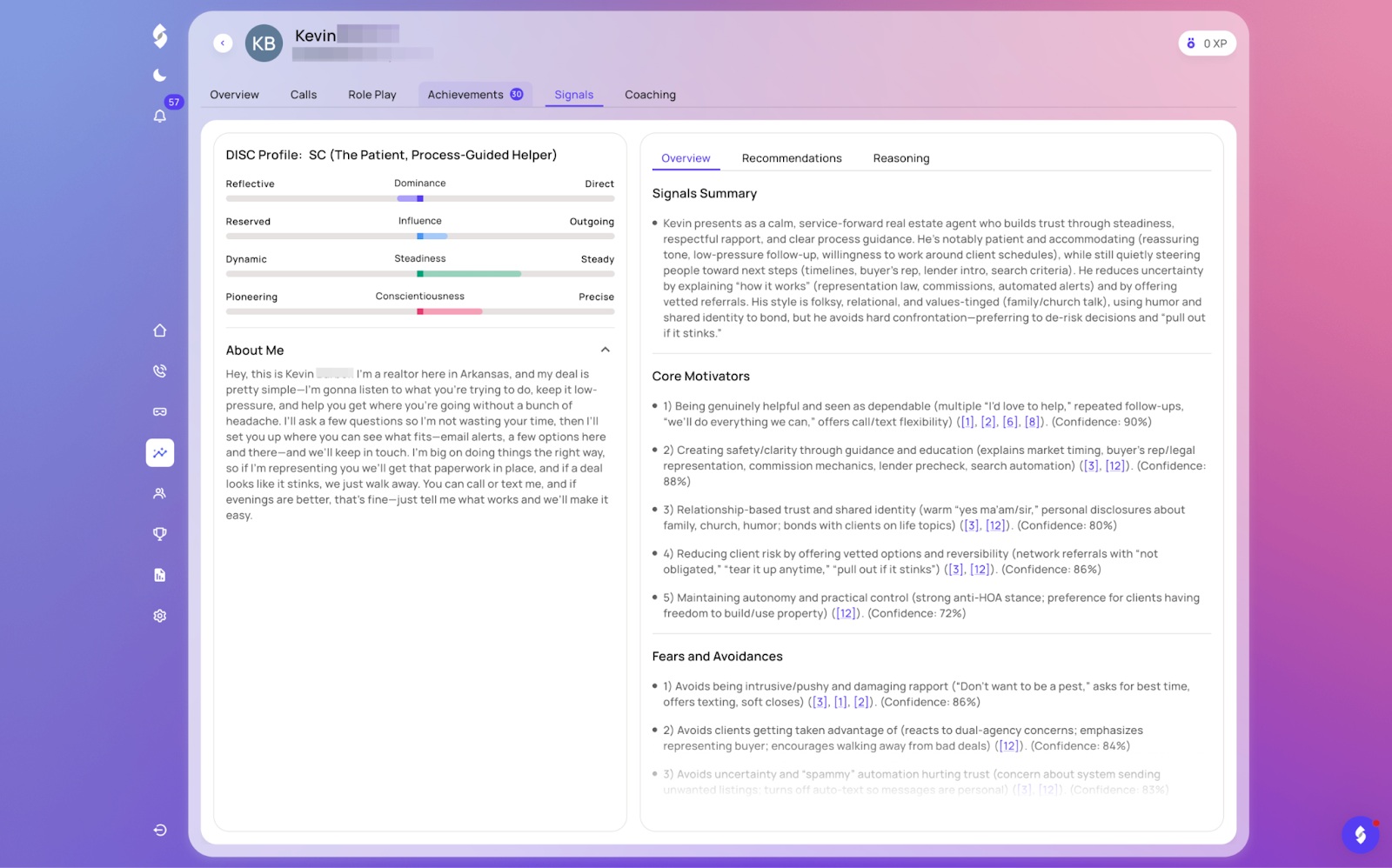
- DiSC spectrum scores, not just a single letter, but a nuanced breakdown across all four dimensions showing where the agent falls on each scale
- An “About Me” narrative, a plain language summary of how the agent actually communicates, drawn from patterns in their calls
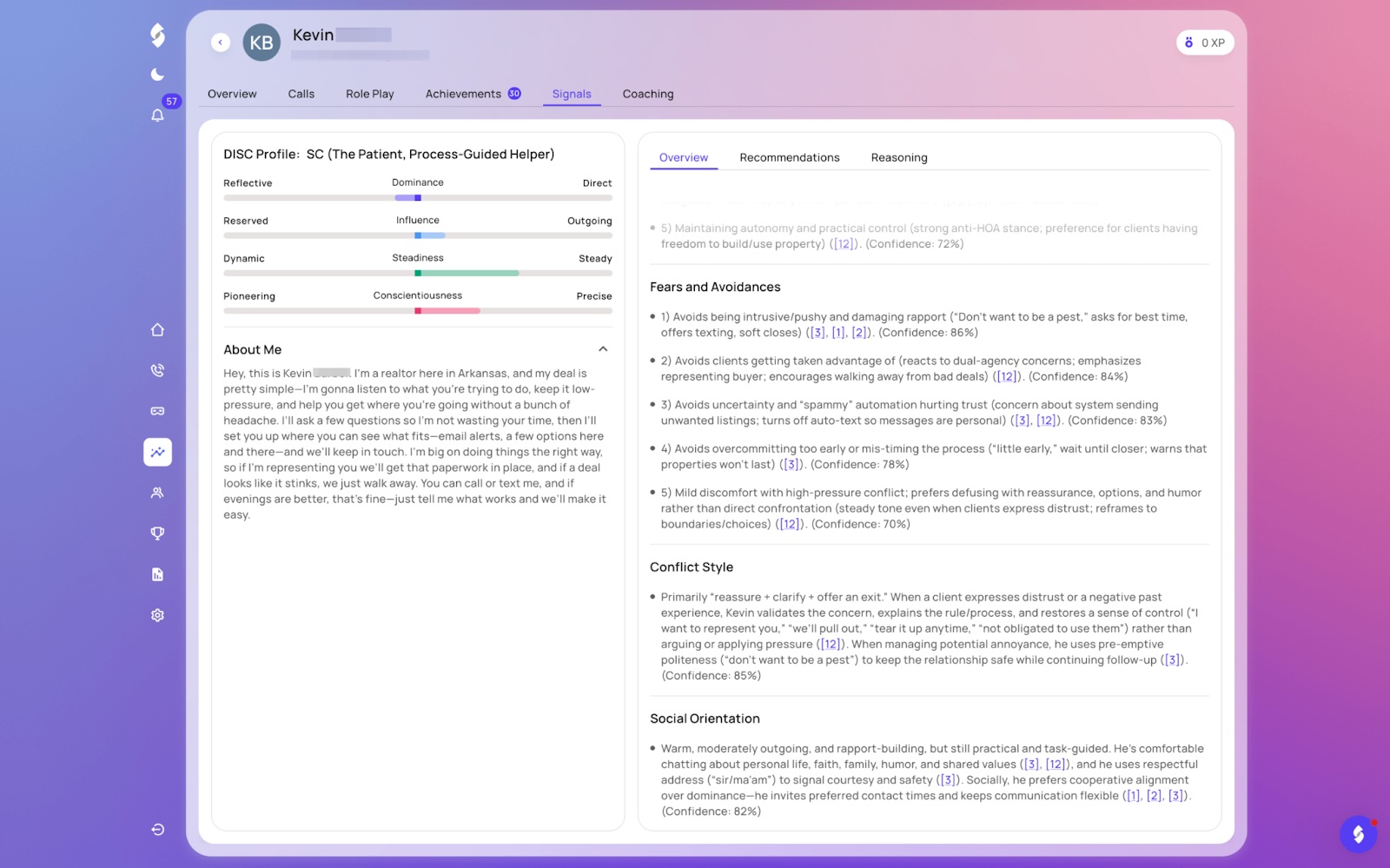
- Core motivations and fears, what drives the agent forward and what holds them back
- Conflict style and social orientation, how the agent handles pushback and builds rapport
- Personalized coaching recommendations, specific, actionable guidance tailored to the agent’s unique DiSC mix
The key differentiator is that every insight is linked back to specific calls with confidence scores. Team leaders don’t just get a label. They get an audit trail showing why the platform identified an agent as a particular type and which calls informed the recommendation.
Why This Matters for Team Leaders and Brokers
Here’s where it gets interesting from an operational standpoint.
Coaching becomes precise, not generic. Instead of running the same objection handling script with every agent, a team leader can see that their high SC agent needs to lead with the fastest path to listing when talking to high D clients and save the process details for the end. That’s a real example Shilo has cited from the platform. The coaching recommendation isn’t theoretical. It’s derived from how that specific agent actually talks.
You can make better role assignments. Signals gives leaders a framework to decide which agents should be working the phones, which should focus on in person consultations, and how scripts should be adjusted for different communication styles. Not every agent thrives in every channel, and having data to back those decisions is more productive than guessing.
Profiles evolve over time. As agents make more calls, Signals updates their profiles and confidence levels. New patterns surface new suggestions. An agent who was tentative six months ago but has grown more assertive will see their profile reflect that shift automatically. This addresses one of the biggest shortcomings of traditional assessments: they go stale.
It could reduce agent churn. This is the less obvious angle. Agents who feel like they’re getting coached in a way that actually fits how they think and operate tend to stay longer. One size fits all training programs are a known contributor to attrition, especially for agents whose natural style doesn’t align with whatever script the team happens to be running.
The Bigger Picture: Personality Aware AI in Real Estate
Signals sits at the intersection of two trends that are reshaping how teams operate.
The first is conversation intelligence, the idea that the calls your team is already making contain a goldmine of data about performance, client sentiment, and coaching opportunities. Shilo has been building in this space since its founding.
The second trend is personalized coaching at scale. Most teams above 15 to 20 agents simply can’t provide individualized coaching to everyone. The math doesn’t work. Tools like Signals offer a path to giving every agent a personalized development plan without requiring the team leader to personally review hundreds of hours of calls.
Whether Shilo’s specific implementation becomes the standard or not, the underlying shift is significant. AI is moving from telling agents what to say to understanding how each agent naturally communicates and coaching from that foundation.
About Shilo
Shilo is an AI conversation intelligence platform built for real estate and mortgage teams that want more than call tracking. The platform helps leaders understand how conversations are actually going, where performance is breaking down, and how to coach more effectively at both the agent and organizational level. Beyond call scoring and coaching, Shilo also connects conversation data back to the systems teams already use, with integrations across major real estate CRMs and an enterprise ready API for companies that want deeper customization.
What to Watch For
Signals is available now within the Shilo platform. For teams already using Shilo for call analysis, it’s a natural extension. For those evaluating conversation intelligence tools for the first time, Signals raises the bar for what coaching insights should look like, grounded in actual behavior, not self reported surveys.
We’ll be keeping an eye on how teams implement this and whether the personality aware approach delivers measurable improvements in conversion and retention. If you’re using Signals or exploring it, we’d love to hear about your experience.